


Lawsuits Look Out For Blind At ATM Machines
A series of federal lawsuits seek to bring banks, including some with local branches, into compliance with the Americans with Disabilities Act by forcing them to make all automated teller machines accessible to the blind.
Approximately 146 cases have been filed since December against banks in Pennsylvania, New Jersey, Ohio and Texas on behalf of blind individuals.
United States Supreme Court To Decide Whether Settlement Offer Can Moot FLSA Suit
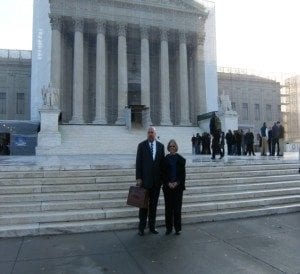
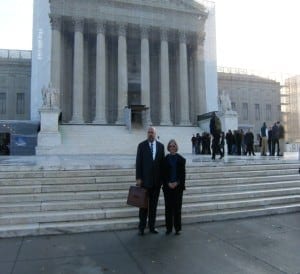
Gary F. Lynch and Laura Symczyk on the steps of the United States Supreme Court
On December 3, 2012, the United States Supreme Court heard argument in Genesis v. Symczyk, a case in which Gary F. Lynch served as Counsel of Record on behalf of Respondent Laura Symczyk.
Case Background: Between April and December of 2007, Laura Symczyk worked as a Registered Nurse at a healthcare facility in Philadelphia. In December, 2009, Lynch Carpenter initiated a putative collective action on behalf of Ms. Symczyk and all similarly situated individuals in the Eastern District of Pennsylvania against the facility owners, Genesis HealthCare Corporation and ElderCare Resources Corporation. Ms. Symczyk alleged that Genesis violated Section 216(b) of the Fair Labor Standards Act (“FLSA”) by automatically deducting meal break time from the pay of certain employees, including her, regardless of whether the employees actually performed compensable work during their breaks.
In February, 2010, Genesis served Ms. Symczyk with an offer of judgment under Federal Rule of Civil Procedure 68 in the amount of $7,500 for her alleged unpaid wages. Ms. Symczyk did not accept the offer.
In March, 2010, Genesis filed a motion to dismiss the lawsuit for lack of subject matter jurisdiction. The district court tentatively granted the motion in May, 2010, finding that Genesis’s offer mooted the collective action, which no one other than Ms. Symczyk had yet joined. The court accepted Genesis’s argument that Ms. Symczyk effectively rejected its offer by failing to respond within the 14 days permitted under Rule 68, and that Ms. Symczyk, as the lone plaintiff, no longer had a personal stake or legal interest in the case, necessary for the court’s subject matter jurisdiction under Article III of the Constitution.
On appeal, Mr. Lynch, arguing on behalf of Ms. Symczyk, convinced the United States Court of Appeal for the Third Circuit to reverse the decision of the district court. The Third Circuit agreed with Lynch Carpenter’s argument, finding that Ms. Symczyk was entitled to move for conditional certification of her collective action before Genesis could moot the case through an offer of judgment. The Third Circuit reasoned that it would be unfair and inefficient to allow defendants to prevent the formation of collective actions by “picking off” plaintiffs with offers of judgment before they could move for certification.
After the Third Circuit denied rehearing, Genesis appealed to the United States Supreme Court. The Supreme Court granted certiorari on June 25, 2012 to determine whether a collective action brought under Section 216(b) of the FLSA becomes moot when the lone plaintiff receives a complete offer of judgment from the defendant under Rule 68 before any other potential plaintiffs have joined the case. To assist with the Supreme Court appeal, Mr. Lynch assembled a team of Supreme Court specialists, including Neal Kumar Katyal, former Acting Solicitor General of the United States, and Adina Rosenbaum of Public Citizen Litigation Group.
The High Court Hears Argument: The United States Supreme Court heard oral arguments in the case at 10:00 a.m. on Monday, December 3, 2012. Genesis’ lawyer, Columbia professor Ronald J. Mann, faced tough questioning from the outset from Justices Ruth Bader Ginsburg, Sonia Sotomayor, and Elena Kagan, and he did not help his client’s cause by dismissing the question of taking care of Ms. Symczyk’s co-workers as “a housekeeping issue” for the courts. Early in the argument, it appeared that the women on the bench were sympathetic not only to Ms. Symczyk, but also to her co-workers, all of whom had been docked thirty minutes of pay per shift for lunch breaks that most simply were unable to take.
Although Mann insisted that Genesis had been willing to pay the entire $7,500 that it figured it owed Ms. Symczyk, his comments did not seem to reassure Justices Ginsburg and Sotomayor, both of whom questioned whether Genesis was surreptitiously trying to avoid liability for Ms. Symczyk’s co-workers, or Justice Kagan, who candidly stated that Ms. Symczyk herself wound up with “nothing.” That, Justice Kagan said, was scarcely merely “a housekeeping issue.” Justice Ginsburg also accused Genesis of failing to give the district court an opportunity to address the co-workers’ claim, rushing in to thwart it at the first chance.
The professor, it seemed, was getting nowhere in his efforts to convince Justices Ginsburg, Sotomayor, and Kagan that Ms. Symczyk could not “take yes for an answer.” These three Members of the Court perceived an obvious injustice, both in Ms. Symczyk’s own loss, and in what they seemingly viewed as lawyerly manipulation of the case to get it out of court for little more than $7,500 and attorney’s fees.
Justice Antonin Scalia briefly sought to come to Mann’s rescue, proposing an argument that the professor had not made at the lectern, i.e., that Ms. Symczyk perhaps did not have standing to make a case, for herself or her co-workers, because she could have accepted Genesis’ offer, but did not.
When Washington attorney Neal Kumar Katyal took his turn on behalf of Ms. Symczyk, the Court’s conservatives then took theirs. First, Chief Justice John G. Roberts, Jr., questioned whether Ms. Symczyk had adequately preserved her argument that an unaccepted settlement offer can never make a lawsuit moot. Justice Sotomayor then got involved again, reinforcing Mr. Katyal’s points by asking him to acknowledge that at no time had Ms. Symczyk accepted the pay-off offer, nor had she ever conceded that the offer was adequate.
Chief Justice Roberts, joined by Justice Scalia, then challenged Mr. Katyal on various procedural issues. Once more, however, Justices Sotomayor and Ginsburg entered, this time to debate those very points. The Chief Justice returned with a suggestion that, with none of Ms. Symczyk’s co-workers formally in the case at the time Genesis made its offer, there were no other parties whose interests the judge could weigh. Mr. Katyal countered that it would make no sense to have a case filed in part on behalf of Symczyk’s co-workers, only to be impeded before there was any opportunity to discern whether any of those employees wished to join the suit. Moreover, Mr. Katyal told Justice Scalia, there was no motive for workers bringing a collective overtime action to delay pursuit of the case, “because the clock is literally ticking.”
Justice Kennedy entered the argument at that point to question Mr. Katyal as to whether the co-workers would have objected if the lower court judge had had an opportunity to rule that the offer to Ms. Symczyk was full relief that had to be enforced. Mr. Katyal replied that Ms. Symczyk had requested a fairness hearing concerning the adequacy of the offer, but never got it. In any event, he added, “an offer that never gave Ms. Symczyk anything is one that didn’t make her whole.”
Ms. Symczyk’s legal team received support from Assistant to the U.S. Solicitor General Anthony A. Yang. The federal government participated in the case to make the argument that, if a settlement offer is not actually accepted, there is no basis for ending the case as moot. “Respondent has never been compensated for her individual damage claim, nor has she received a court judgment favorably adjudicating that claim,” Yang told the court. “It follows that her individual claim remains live, as does this collective action.”
Following argument, Lynch Carpenter partner Gary F. Lynch, lead counsel for Ms. Symczyk, stated that he was encouraged by the questioning of the Justices, and that he remains hopeful that the Court will issue a decision which will serve to protect collective action mechanism under the FLSA from being undermined by early offers of judgment to the named plaintiff or plaintiffs.
Click Here to Access the United States Supreme Court Docket for this Case (Opens in a new window)