


Lynch Carpenter Investigates Milan Eye Center Data Breach for Thousands of Victims
Milan Eye Center recently announced that it suffered from a cybersecurity attack between May 18, 2020 to July 23, 2020, that impacted the personal information of thousands of individuals. The information potentially impacted in the breach includes individuals’ full names, dates of birth, telephone numbers, insurance coverage information, social security numbers, location where services were provided, dates of service, and health statuses.
Lynch Carpenter, LLP is investigating claims against Milan Eye Center related to this data breach. If you are a current or former patient or member that received services from Milan Eye Center on or before July 23, 2020, you may be entitled to compensation.
If you have received a notification from Milan Eye Center that your information was impacted, please call Patrick Donathen at (412) 322-9243, email him at patrick@lcllp.com, or fill out our contact form at www.lynchcarpenter.com/contact.
About Lynch Carpenter
Lynch Carpenter is a national class action law firm with offices in Pennsylvania, California, and Illinois. Our firm has represented millions of clients in data privacy matters for more than a decade and has earned national acclaim for complex litigation for plaintiffs across the country. To learn more, please visit www.lynchcarpenter.com.
Lynch Carpenter Helping Employees of Forever21 Affected by Data Breach
F21 OpCo LLC (d/b/a Forever21) recently announced that it suffered from a cybersecurity attack on or around August 4, 2023, that impacted the personal information of hundreds of thousands of individuals. The information potentially impacted in the breach includes name, Social Security number, date of birth, bank account number, and information regarding your Forever21 health plan, including enrollment and premiums paid.
Lynch Carpenter, LLP is investigating claims against Forever21 related to this data breach. If you are a current or former employee of Forever21, you may be entitled to compensation.
If you have received a notification from Forever21 that your information was impacted, please call Patrick Donathen at (412) 322-9243, email him at patrick@lcllp.com, or fill out our contact form at www.lynchcarpenter.com/contact.
About Lynch Carpenter
Lynch Carpenter is a national class action law firm with offices in Pennsylvania, California, and Illinois. Our firm has represented millions of clients in data privacy matters for more than a decade and has earned national acclaim for complex litigation for plaintiffs across the country. To learn more, please visit www.lynchcarpenter.com.

Lynch Carpenter, LLP Fights for Individuals Affected by Prospect Medical Holdings, LLC Data Breach
Prospect Medical Holdings, a healthcare system that operates facilities in California, Connecticut, Pennsylvania, Rhode Island, and New Jersey was recently hit with a ransomware attack on or about August 3, 2023, that likely impacted the personal information of hundreds of thousands of individuals. The information potentially impacted in the breach includes individuals’ Social Security Numbers, driver’s license numbers, and medical information.
Lynch Carpenter, LLP is investigating claims against Prospect Medical Holdings related to this data breach. If you are a current or former patient of Prospect Medical Holdings, you may be entitled to compensation.
If you have received a notification from Prospect Medical Holdings that your information was impacted, please call Patrick Donathen at (412) 322-9243, email him at patrick@lcllp.com, or fill out our contact form at www.lynchcarpenter.com/contact.
About Lynch Carpenter
Lynch Carpenter is a national class action law firm with offices in Pennsylvania, California, and Illinois. Our firm has represented millions of clients in data privacy matters for more than a decade and has earned national acclaim for complex litigation for plaintiffs across the country. To learn more, please visit www.lynchcarpenter.com.

Lynch Carpenter Investigates Claims in Data Media Associates Data Breach
Data Media Associates recently announced that it suffered from a cybersecurity attack on or around May 31, 2023, that impacted the personal information of thousands of individuals. The information potentially impacted in the breach includes: names; addresses; medical or health insurance information that would appear on billing statements, invoices, or other claims-related documents; and in some instances health insurance ID numbers which may be the same as an individual’s Society Security Number.
Lynch Carpenter, LLP is investigating claims against Data Media Associates related to this data breach. If you received a data breach notification from Data Media Associates, you may be entitled to compensation.
If you have received a notification from Data Media Associates that your information was impacted, please call Patrick Donathen at (412) 322-9243, email him at patrick@lcllp.com, or fill out our contact form at www.lynchcarpenter.com/contact.
About Lynch Carpenter
Lynch Carpenter is a national class action law firm with offices in Pennsylvania, California, and Illinois. Our firm has represented millions of clients in data privacy matters for more than a decade and has earned national acclaim for complex litigation for plaintiffs across the country. To learn more, please visit www.lynchcarpenter.com.

Lynch Carpenter Investigates Alogent Data Breach
Alogent Holdings, Inc. recently announced that it suffered from a cybersecurity attack on or around May 31, 2023, that impacted the personal information of hundreds of thousands of individuals. The information potentially impacted in the breach includes individuals’ account and routing numbers, names, addresses, phone numbers, check payees, and remittance amounts.
Lynch Carpenter, LLP is investigating claims against Alogent related to this data breach. If you are a customer of Huntington Bank who has had a check processed by Alogent, you may be entitled to compensation.
If you have received a notification from Alogent that your information was impacted, please call Patrick Donathen at (412) 322-9243, email him at patrick@lcllp.com, or fill out our contact form at www.lynchcarpenter.com/contact.
About Lynch Carpenter
Lynch Carpenter is a national class action law firm with offices in Pennsylvania, California, and Illinois. Our firm has represented millions of clients in data privacy matters for more than a decade and has earned national acclaim for complex litigation for plaintiffs across the country. To learn more, please visit www.lynchcarpenter.com.

Lynch Carpenter LLP Investigates Cognizant/TMG Health Data Breach
Cognizant / TMG Health recently announced that it suffered from a cybersecurity attack on or around May 30, 2023, that impacted hundreds of thousands of individuals personal information. The information potentially impacted in the breach included: names, addresses, email addresses, phone numbers, dates of birth, Social Security Numbers, claim numbers, bank account numbers and medical service information.
Lynch Carpenter, LLP is investigating claims against Cognizant / TMG Health related to this data breach. If you are a current or former patient or member receiving services from Cognizant / TMG Health, you may be entitled to compensation.
If you have received a notification from Cognizant / TMG Health that your information was impacted, please call Patrick Donathen at (412) 322-9243, email him at patrick@lcllp.com, or fill out our contact form at www.lynchcarpenter.com/contact.
About Lynch Carpenter
Lynch Carpenter is a national class action law firm with offices in Pennsylvania, California, and Illinois. Our firm has represented millions of clients in data privacy matters for more than a decade and has earned national acclaim for complex litigation for plaintiffs across the country. To learn more, please visit www.lynchcarpenter.com.

Lynch Carpenter LLP Fights for 11 Million Affected by HCA Healthcare Data Breach
PITTSBURGH, July 14, 2023 (GLOBE NEWSWIRE) -- On July 10, 2023, HCA Healthcare announced that it suffered a cybersecurity attack that impacted the personal information of approximately 11 million patients. The information potentially impacted in the breach includes: patient names, cities, states, zip codes, email addresses, telephone numbers, dates of birth, gender, service dates, and locations of next appointment.
Lynch Carpenter, LLP is investigating claims against HCA Healthcare related to this data breach. If you are a current or former patient of HCA Healthcare, you may be entitled to compensation.
If you have received a notification from HCA Healthcare that your information was impacted, please call Patrick Donathen at (412) 322-9243, email him at patrick@lcllp.com, or fill out our contact form at www.lynchcarpenter.com/contact.
About Lynch Carpenter
Lynch Carpenter is a national class action law firm with offices in Pennsylvania, California, and Illinois. Our firm has represented millions of clients in data privacy matters for more than a decade and has earned national acclaim for complex litigation for plaintiffs across the country. To learn more, please visit www.lynchcarpenter.com.

Lynch Carpenter LLP Appointed Class Counsel in Barry v. University of Washington
IN THE SUPERIOR COURT OF THE STATE OF WASHINGTON IN AND FOR KING COUNTY
ALEXANDER BARRY, individually and on behalf of all others similarly situated,
Plaintiff,
v.
UNIVERSITY OF WASHINGTON,
Defendant.
No. 20-2-13924-6-SEA
ORDER GRANTING PLAINTIFF’S MOTION FOR CLASS CERTIFICATION
THIS MATTER having come before the Court on Plaintiff’s Motion for Class Certification (the “Motion”), following the Court’s review of the Motion, the papers submitted in support and in response, the hearing thereon, after conducting a rigorous analysis to ensure that the Plaintiff has satisfied the requirements of CR 23(a) and CR 23(b)(3), and good cause appearing, the Motion is hereby GRANTED.
I. STANDARD OF REVIEW
Class actions, authorized by CR 23 in Washington, are an essential tool for adjudicating cases with multiple claims that involve similar factual and/or legal inquiries and that are too modest to prosecute individually. Chavez v. Our Lady of Lourdes Hospital at Pasco, 190 Wash. 2d 507, 514, 415 P.3d 224 (2018) (other citations omitted). Washington courts liberally interpret CR 23 because the rule “avoids multiplicity of litigation, saves members of the class the cost and trouble of filing individual suits, and frees the defendant from the harassment of identical future litigation.” Weston v. Emerald City Pizza, LLC, 137 Wash. App. 164, 168, 151 P.3d 1090 (2007) (quoting Smith v. Behr Process Corp., 113 Wash. App. 306, 318, 54 P.3d 665 (2002) (cleaned up).
To certify a class, Plaintiff must meet all of the requirements under CR 23(a), numerosity, commonality, typicality, and adequacy of representation, and at least one subdivision of 23(b). Schwendeman v. USAA Casualty Insurance Co., 116 Wash. App. 9, 18, 65 P.3d 1 (2003). These rules provide:
(a) Prerequisites to a Class Action. One or more members of a class may sue or be sued as representative parties on behalf of all only if (1) the class is so numerous that joinder of all members is impracticable, (2) there are questions of law or fact common to the class, (3) the claims or defenses of the representative parties are typical of the claims or defenses of the class, and (4) the representative parties will fairly and adequately protect the interest of the class.
(b) Class Actions Maintainable. An action may be maintained as a class action if the prerequisites of subdivision (a) are satisfied, and in addition:
. . . .
(3) The court finds that the questions of law or fact common to the members of the class predominate over any questions affecting only individual members, and that a class action is superior to other available methods for the fair and efficient adjudication of the controversy. The matters pertinent to the findings include: (A) the interest of members of the class in individually controlling the prosecution or defense of separate actions; (B) the extent and nature of any litigation concerning the controversy already commenced by or against members of the class; (C) the desirability or undesirability of concentrating the litigation of the claims in the particular forum; (D) the difficulties likely to be encountered in the management of a class action.
CR 23(a); CR 23(b)(3). As noted further below and in the Court’s oral ruling on June 28, 2023, incorporated herein, the proposed class meets the requirements of CR 23(a) and CR 23(b)(3).
II. THIS CASE SATISFIES THE CR 23(a) PREREQUISITES
To start, Plaintiffs have carried their burden of demonstrating this case meets each of the four CR 23(a) prerequisites.
CR 23(a)(1) Numerosity. First, CR 23(a)(1) requires that a class be so numerous that joinder of all members is impracticable. When a class is large, joinder is usually impracticable. Jordan v. County of Los Angeles, 669 F.2d 1311, 1319 (9th Cir. 1982). Joinder is generally deemed impracticable in classes with over 40 members. Chavez, 190 Wash. 2d at 520. Here, numerosity is satisfied because the proposed class contains over 56,000 members, including undergraduate and graduate students. Compl. ¶ 24. See Little v. Grand Canyon Univ., No. CV-20-00795-PHX-SMB, 2022 WL 266726, at *5 (D. Ariz. Jan. 28, 2022) (finding numerosity met and certifying class in COVID-19 fee refund case where proposed class included over 20,000 students).
CR 23(a)(2) Commonality. Second, the commonality element of Rule 23(a)(2) requires only that “there are questions of law or fact common to the class.” CR 23(a)(2). “Commonality” under CR 23(a)(2) is a “low threshold test” that “is qualitative rather than quantitative, that is, there need be only a single issue common to all members of the class.” Smith, 113 Wash. App. at 320. Commonality is met if the “course of conduct” that gives rise to the cause of action affects all the class members. Pellino v. Brink’s Inc., 164 Wash. App. 668, 682, 267 P.3d 383 (2011) (commonality satisfied when alleged facts indicate defendant was engaged in common course of conduct in relation to all potential class members). Plaintiff satisfies the low commonality hurdle. Common issues here include: (1) whether UW and Class members had a contract; (2) whether those contracts obligated UW to provide in-person instruction; (3) whether those contracts obligated UW to provide access to campus facilities and in-person resources; (4) whether UW breached the contracts; (5) whether UW unlawfully kept funds paid; (6) whether UW was unjustly enriched by keeping the funds paid; and (7) the fact and measure of damages derived from verifiable class-wide information maintained by UW. Commonality is met because the proof will focus on UW’s conduct and will be common to the Class.
CR 23(a)(3) Typicality. Third, CR 23(a)(3) requires that the “claims or defenses of the representative parties [be] typical of the claims or defenses of the class.” CR 23(a)(3). The typicality requirement is met when the claims of the representative plaintiffs arise from the same course of conduct that gives rise to the claims of the other class members, and where the claims are based upon similar legal theories. John Doe L v. Pierce County, 7 Wash. App. 2d 157, 203, 433 P.3d 838 (2018) (citing Pellino,164 Wash. App. at 684). Here, Plaintiff’s claims are typical because they arise from the same events and course of conduct and common legal and remedial theories. Plaintiff’s claims, like those of Class members, stem from a contract with UW for the provision of in-person education and access to campus facilities and in-person resources. Plaintiff, like members of the Class, was billed by UW for tuition and fees specific to students who registered for in-person courses; and paid the demanded tuition and fees. Compl. ¶ 8. UW stopped providing the promised in-person instruction and access to campus facilities and in-person resources for all students simultaneously. Def. Ans. ¶ 3. UW then retained full price for tuition and fees. Plaintiff alleges UW must refund the pro-rated fees for campus access and in-person resources that UW did not provide when it shuttered its campus. Defendant raises factual differences between students to oppose this finding. These issues stray into the merits of Plaintiff’s allegations and his burden of proof as to the claims. Those issues need not be determined at this stage. Since each Class member’s claims arise from the same course of UW’s conduct, and each Class member makes similar legal arguments, the typicality requirement is met.
CR 23(a)(4) Adequacy. For the final CR 23(a) prerequisite, CR 23(a)(4) requires that the representative parties will “fairly and adequately protect the interests of the class.” CR 23(a)(4). CR 23(a)(4) utilizes a two-part test is: (1) whether any substantial conflicts of interest exist between the representatives and the class; and (2) whether the representatives will prosecute the action vigorously on behalf of the class. Hanlon v. Chrysler Corp., 150 F.3d 1011, 1020 (9th Cir. 1998). Plaintiff and his counsel satisfy both parts of this test.
First, the Court finds that Plaintiff’s interests are aligned with those of Class members in obtaining a recovery that will provide each with the benefit of their bargain. In addition to these aligned interests, Plaintiff has no conflicts with the Class and seeks to hold UW accountable. Plaintiff has committed to prosecuting this litigation and will continue to advocate for the best interests of the Class. Plaintiff and proposed Class Counsel will vigorously represent the Class.
In addition, proposed Class Counsel, Hagens Berman Sobol Shapiro LLP and Lynch Carpenter LLP are each qualified. Both law firms include experienced class action lawyers, with success in litigating issues relating to the provision of in-person education and campus access during the Spring 2020 quarter, working together and separately. Plaintiff and proposed Class Counsel satisfy the adequacy inquiry, satisfying each requirement of CR 23(a).
III. CR 23(B)(3)’S PREDOMINANCE AND SUPERIORITY REQUIREMENTS ALSO ARE MET HERE
Next, CR 23(b)(3) permits class certification if “common questions of law predominate over questions affecting only individual members and that a class action is the superior method of handling the claim.” CR 23(b)(3).
A. Common issues predominate given the central issues raised in this litigation.
Predominance tests whether the proposed class is sufficiently cohesive to call for adjudication by representation. Amchem Products, Inc. v. Windsor, 521 U.S. 591, 623 (1997) “[T]he predominance requirement is not defeated merely because individual factual or legal issues exist; rather, the relevant inquiry is whether the issue shared by the class members is the dominant, central, or overriding issue shared by the class.” Miller v. Farmer Bros. Co., 115 Wash. App. 815, 825, 64 P.3d 49 (2003). When one or more of the central issues are common to the class and can be said to predominate, the action may be considered proper under CR 23(b)(3), “even though other important matters will have to be tried separately, such as damages or some defenses peculiar to some individual class members.” Tyson Foods Inc. v. Bouaphakeo, 577 U.S. 422, 453 (2016). In determining whether predominance is met, the court engages “in a pragmatic inquiry into whether there is a common nucleus of operative facts to each class member’s claim.” Smith, 113 Wash. App. at 323. The “predominance standard is not strictly applied to every aspect of the plaintiffs’ claims; rather, questions of judicial economy are central.” Sitton, 116 Wash. App. at 255. Here, this Court concludes that common questions predominate. Plaintiff identifies key evidence common for all Class members, such as: whether UW, based on UW’s conduct and representations, including during enrollment, course registration, billing, and payment, and students paying tuition and fees, formed a contract that required UW to provide in-person instruction and access to facilities and in-person services; whether UW breached that contract when it closed campus; and the calculation of damages. This evidence directly affects every Class member’s effort to show liability and every Class member’s entitlement to relief.
Defendant targets much of its opposition to class certification here, arguing Plaintiff’s proposed methodology is flawed. It does not and cannot, the argument goes, account for myriad differences between class members to place a value on the education for which an individual paid and, accordingly, how the change to remote learning at the height of the Covid-19 pandemic may have affected or reduced that value. The Court finds that these issues also are properly raised on the merits of Plaintiffs’ allegations and methodology for calculating damages. Defendant will have the opportunity on the merits to challenge and dispute Plaintiff’s claims. Even if some individual differences among class members are shown, the essential question here is whether allegations arise from a “common nucleus of operative facts”. Smith, 113 Wash. App. at 323. Plaintiff will present the same class-wide evidence that UW’s course of conduct, transitioning to online-only education, caused economic loss to Plaintiff and Class members. These common issues predominate over any individual issues, rendering class treatment appropriate.
B. A class action is superior to individual actions covering the same issues and arising out the same transition to remote learning.
The Court finds that a class action here is superior to the alternative of individual actions. Where individual damages are small, the class vehicle is usually deemed superior. Chavez, 190 Wash. 2d at 523. “[F]orcing numerous plaintiffs to litigate the alleged pattern or practice … in repeated individual trials runs counter to the very purpose of a class action.” Sitton, 116 Wash. App. at 256–57. CR 23(b)(3) includes four factors for this inquiry: “(A) the interest of members of the class in individually controlling the prosecution or defense of separate actions; (B) the extent and nature of any litigation concerning the controversy already commenced by or against members of the class; (C) the desirability or undesirability of concentrating the litigation of the claims in the particular forum; (D) the difficulties likely to be encountered in the management of a class action.” CR 23(b)(3). Here, class action treatment is superior to adjudicate the claims in this matter.
The first factor favors certification because it would cost Class members more to litigate this action individually than the relatively small amount of damages they will recover. There is no reason to believe putative Class members have any interest in controlling the litigation.
The second factor favors class certification, as neither Plaintiff nor his counsel are aware of any other litigation regarding this matter against UW. See Barry Decl. ¶ 10; Kurowski Decl. ¶ 15; Ciolko Decl. ¶ 8.
The third superiority factor also favors certification. This Court is the logical and desirable forum as UW is located in King County, where this case is being litigated, and the Court is familiar with the factual and legal issues. Holding separate trials for claims that could be tried together would be costly and inefficient. Elter v. United Servs. Auto. Ass’n, 17 Wash. App. 2d 643, 661, 487 P.3d 539 (2021), review denied sub nom. Elter v. USAA Cas. Ins., 198 Wash. 2d 1027, 498 P.3d 957 (2021).
The final superiority factor—manageability—focuses on the “practical problems that may render the class action format inappropriate for a particular suit.” Eisen v. Carlisle & Jacquelin, 417 U.S. 156, 164 (1974). That individual issues might exist or take some time to resolve does not make a class action unmanageable. Chavez, 190 Wash. 2d at 521. Trial courts have a “variety of procedural options to reduce the burden of resolving individual damage issues, including bifurcated trials, use of subclasses or masters, pilot or test cases with selected class members, or even class decertification after liability is determined.” Sitton, 116 Wash. App. at 255. This case can be tried in an efficient matter, and the Court foresees no manageability problems that make over 56,000 individual actions a better alternative. As a result, Plaintiff shows the superiority prong of CR 23(b)(3) has been met here.
IV. THE PROPOSED CLASS IS ASCERTAINABLE
While CR 23 does not explicitly include an ascertainability requirement, some appellate courts have reviewed ascertainability issues in evaluating appeals from class certifications. See Elter, 17 Wash. App. 2d 643, 658 (affirming class certification noting that appellant “also argues that ‘ascertainability’ was not satisfied. But CR 23 does not list an ‘ascertainability’ requirement” and conducting no further analysis of the argument). In doing so, such courts direct simply that “[t]he definition must include objective rather than subjective criteria that makes the plaintiff class identifiable.” Barnett v. Wal-Mart Stores, Inc., 133 Wash. App. 1036 (2006). See also Kihuria v. Consumer Legal Servs. Am., Inc., 5 Wash. App. 2d 1001 (2018) (“The class must be sufficiently identifiable without being overly broad. The class should not be defined by criteria that are subjective or that require an analysis of the merits of the case.”) (citations omitted). The proposed Class meets this standard. The condition for class membership is students who paid UW tuition and fees for access to a suite of promised in-person educational services during the Winter and Spring 2020 quarters that UW did not provide. This definition uses precise and objective criteria to identify Class members using UW’s student and payment records.
V. CONCLUSION
Plaintiff has satisfied the requirements of CR 23(a) and CR 23(b)(3). Accordingly, IT IS HEREBY ORDERED as follows:
1. The Court certifies the following Class:
All students who were enrolled in and paid for the University of Washington’s in-person based educational programs, services, and courses for the Winter Quarter 2020 or Spring Quarter 2020 academic term(s).
Excluded from the Class is UW, any entity in which UW has a controlling interest, and UW’s legal representatives, predecessors, successors, assigns, and non-student employees. Further excluded from the Class is this Court and its employees.
2. The Court appoints Plaintiff Alexander Barry as Class Representative.
3. The Court appoints Hagens Berman Sobol Shapiro LLP and Lynch Carpenter, LLP as Class Counsel.
4. The Court directs that notice issue to certified Class members under CR 23(d)(2) and further directs that UW provide Plaintiff’s counsel with last known Class member email and mailing address contact information. The parties shall confer and determine a realistic schedule to prepare and send notice to Class members. This Order shall constitute a “judicial order” within the meaning of the Family Educational Rights and Privacy Act, 20 U.S.C. § 1232g and 34 C.F.R. § 99.31(a)(9), sufficient to compel the University of Washington to provide this information.
DATED:
HONORABLE JUDITH H. RAMSEYER
KING COUNTY SUPERIOR COURT JUDGE
[Proposed order prepared by Hagens Berman Sobol Shapiro LLP]
King County Superior Court
Judicial Electronic Signature Page
Case Number: 20-2-13924-6
Case Title: BARRY VS UNIVERSITY OF WASHINGTON ET AL
Document Title: ORDER RE GRANTING CLASS CERTIFICATION
Signed By: Judith H. Ramseyer
Date: June 28, 2023
Judge: Judith H. Ramseyer
This document is signed in accordance with the provisions in GR 30.
Certificate Hash: 08B04919A6905EC38077251FA81017A01DA60A76
Certificate effective date: 7/16/2023 2:34:55 PM
Certificate expiry date: 7/16/2023 2:34:55 PM
Certificate Issued by: C=US, E=kcscefiling@kingcounty.gov, OU=KCDJA, O=KCDJA, CN=”Judith Ramseyer: BBvO7QrS5hGe+MT2AFk6yQ==”

CalPERS Cybersecurity Attack Being Investigated by Lynch Carpenter LLP
PITTSBURGH, July 10, 2023 (GLOBE NEWSWIRE) -- CalPERS recently announced that a third-party vendor PBI Research Services/Berwyn Group (PBI) suffered from a cybersecurity attack on May 29, 2023 that impacted hundreds of thousands of individuals personal information. The information potentially impacted in the breach included: first and last name; date of birth; and Social Security number. It could have also included the names of former or current employers, spouses or domestic partners, and children.
Lynch Carpenter, LLP is investigating claims against CalPERS and PBI related to this data breach. If you are a current or former employee or member receiving benefits from CalPERS, you may be entitled to compensation.
If you have received a notification from CalPERS that your information was impacted, please call Patrick Donathen at (412) 322-9243, email him at patrick@lcllp.com, or fill out our contact form at www.lynchcarpenter.com/contact.
About Lynch Carpenter
Lynch Carpenter is a national class action law firm with offices in Pennsylvania, California, and Illinois. Our firm has represented millions of clients in data privacy matters for more than a decade and has earned national acclaim for complex litigation for plaintiffs across the country. To learn more, please visit www.lynchcarpenter.com.
Lynch Carpenter Supports the Pittsburgh Community through the Allegheny Country Bar Association
Bar associations offer many benefits to lawyers that complement and further the practice of law. Those benefits include pertinent information about practice trends, continuing legal education (CLE) courses, building camaraderie and professional relationships, discovering or cultivating a professional skill set, and volunteer and pro bono opportunities. The associations can be mandatory, such as a state regulatory bar association, or voluntary, like the American Bar Association. While serving lawyer members in cities, counties, regions, nationally, or internationally, bar associations also help the public.
Engaging the local community through bar association service and philanthropic work erases doubts and stereotypes surrounding attorneys, strengthening integrity, advocacy, and trust in the profession. Community engagement also breaks down barriers and promotes accessibility to the legal system. The Allegheny County Bar Association (ACBA) has served the Allegheny County legal community since 1870 with a mission “to empower our members; promote a just, accessible and inclusive judicial system; and serve the community at large.” The ACBA welcomes all attorneys and law students. It has numerous sections for lawyers to get involved, including Young Lawyers Division (YLD), Women in the Law Division (WLD), Civil Litigation Section, Homer S. Brown Division (HSB), and LGBTQ+ Rights Committee to name a few.
Many of the attorneys at Lynch Carpenter’s Pittsburgh office are involved with the ACBA. For example, Gary Lynch serves on the ACBA Federal Court Section Council, a position nominated or appointed for a three-year commitment. Kelly Iverson is an active member of the Federal Court Section and Civil Litigation Section. Kelly recently volunteered to judge the Allegheny County High School Mock Trial competition. Jamisen Etzel wrote and instructed an ACBA CLE called Class Action for the Non-Class Action Attorney, which was presented during a “SkiLE” (a day of skiing while collecting a CLE credit on the bus ride to Seven Springs) sponsored by Lynch Carpenter. The firm also sponsored an ACBA Strike Out Hunger event (a game night of bowling with all proceeds benefiting the hunger campaign for the Allegheny County Bar Foundation’s Attorneys Against Hunger). As a firm, our lawyers traveled to the ACBA’s Annual Bench Bar Conference in Seven Springs, an event that encompasses CLEs, opportunities to network, meet more amazing attorneys, and create exciting memories with colleagues.
Even more unique to the ACBA is its zeal to encourage and support its young lawyers (practicing ten years or less). The YLD perpetually facilitates the advancement of its section members through events, education, fundraising, and volunteer work. In YLD programming, the Bar Leadership Initiative (BLI) is offered every year for section members. BLI was designed for young lawyers with little to no involvement with the ACBA to develop leadership and professional skills, while learning the inner workings of the ACBA. Only 15 individuals are selected per class and the class must complete a project.
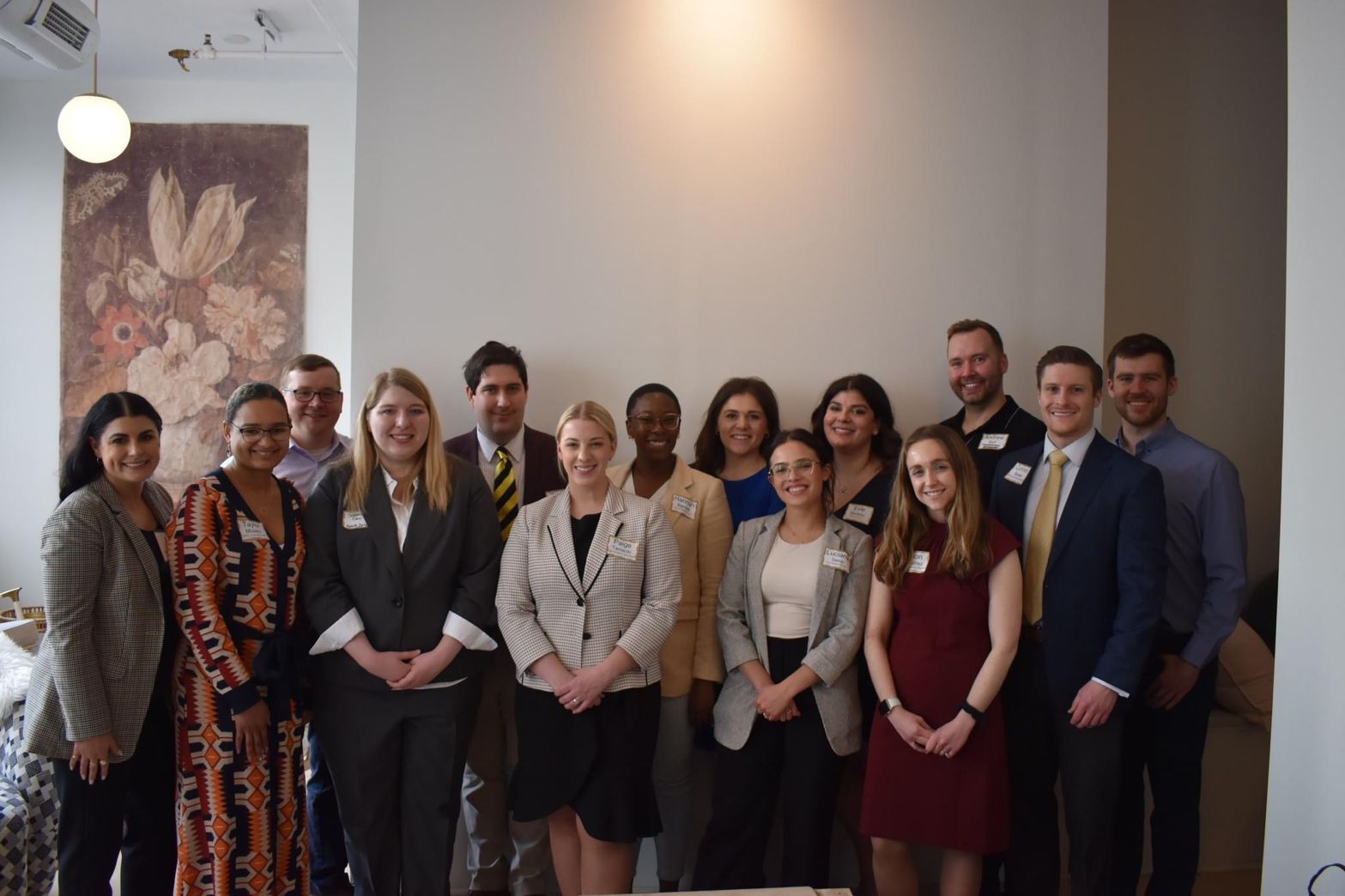
2022 -2023 Bar Leadership Initiative Class
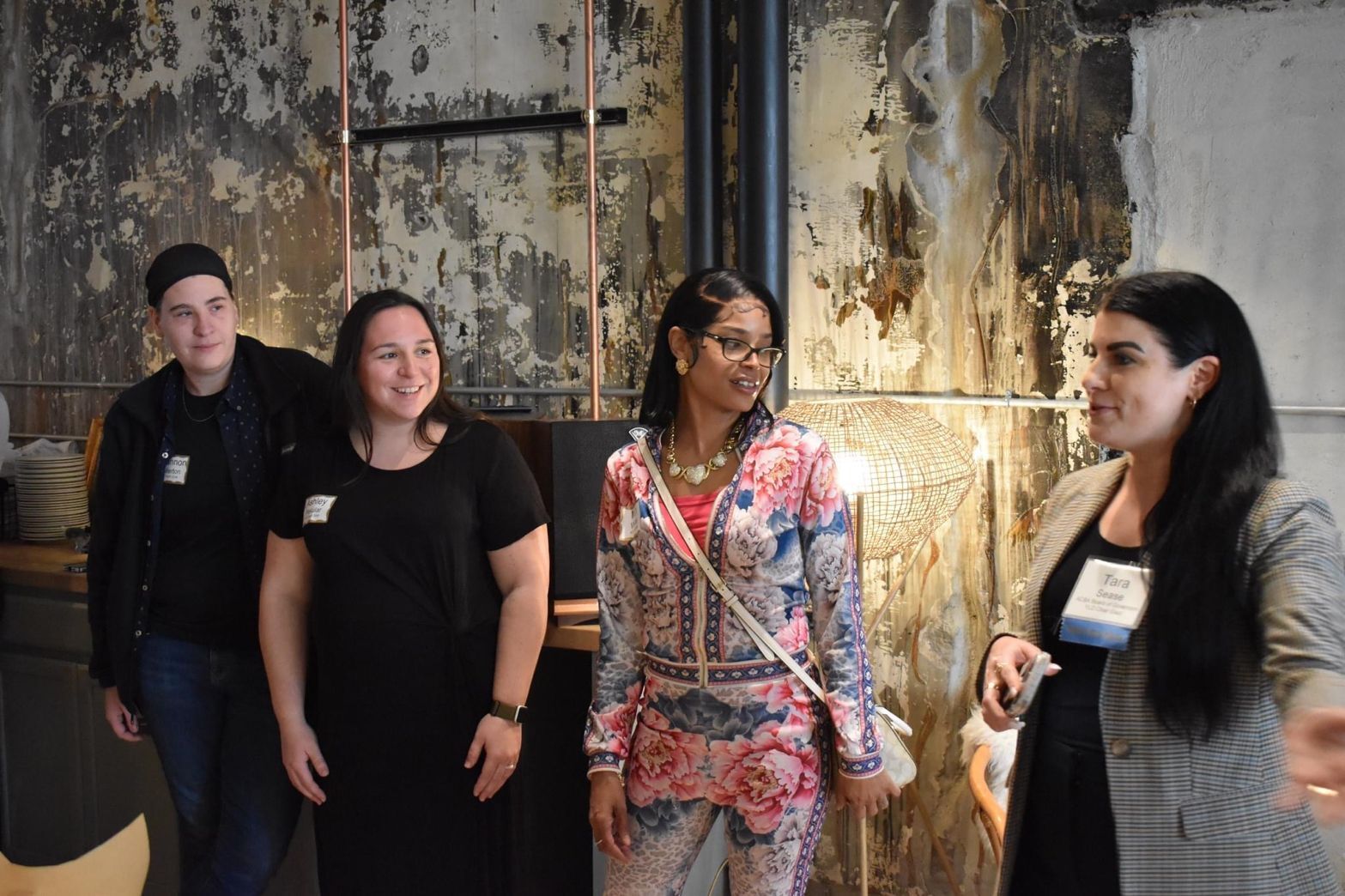
412 Youth Zone Representatives and BLI Chair, Tara Sease, at Luggage with Love Happy Hour
This author was accepted to the 2022-2023 BLI class and participated in this rigorous yet rewarding program. As part of the curriculum, I attended monthly BLI meetings, joined the YLD Education Committee, participated in the YLD Annual Gift Drive, and attended various YLD, ACBA, and other divisions events. With the Education Committee, I volunteered to chair the SkiLE, assisted with other education programs, and offered ideas for upcoming YLD CLEs.
The 2022-2023 BLI class project was Luggage with Love. We collected new or gently used suitcases and bags to donate to 412 Youth Zone to be provided to young adults transitioning out of foster care. Included in the bags were pamphlets with QR codes to basic legal knowledge related to taxes, voting, Miranda rights, and landlord/tenant law, along with toiletries and other necessities. In Pennsylvania, approximately 1,100 children age out of foster care each year, and many have no financial resources. One in four of those children experience homelessness or mental health challenges. 412 Youth Zone was designed to help young people between the ages of 16 and 23 that are transitioning out of foster care and help them to “gain stability, build positive relationships, learn life skills, meet basic needs, foster creative expressions and be guided on the right path towards a brighter future.” The BLI class also planned a happy hour to collect bags and raise funds to purchase additional toiletries. The class delivered over 150 new/gently used luggage/duffel bags and presented 412 Youth Zone with a check in the amount of $1,415 (the total proceeds raised during the happy hour).
For nine months with the BLI, I grew my professional network, learned more about the ACBA structure, and discovered new transferable skills, while strengthening my leadership and professionalism. The experience culminated with a rewarding class project that assisted those youth aging out of foster care, but also raised awareness in the local bar association of 412 Youth Zone and its mission. What’s next after BLI? I am excited to have been nominated for a council position with HSB and plan to continue to serve the legal community.
On a personal note, it’s been an incredible and full-circle experience to be involved with the ACBA, YLD, and HSB. I was placed with an ACBA-affiliated firm in 2011 as part of an HSB summer program for high school students. As a teenager, I was unsure of my future and where I’d be after high school. I’m grateful to the ACBA and the HSB for influencing my decision to become a lawyer. My path now is clear. I’m proud and honored to serve the legal community. Hopefully, my service can spark a positive influence in another person’s life. Each person from my class (and our BLI chair) inspired me to become a better attorney and community leader. I’m happy to have worked with outstanding young attorneys and look forward to more collaboration in the future.
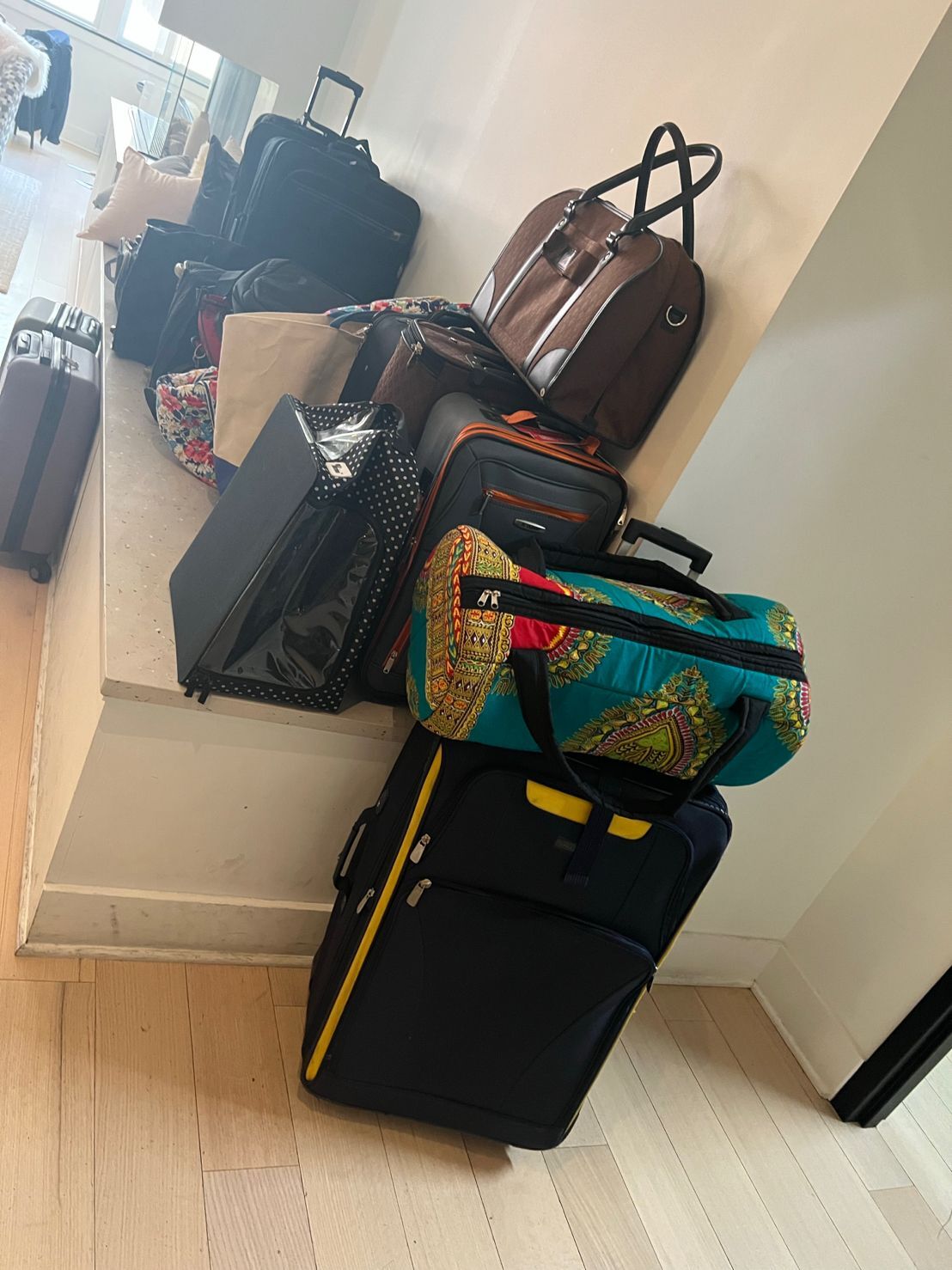
Donations at Luggage with Love Happy Hour
BLI class members presenting check to 412 Youth Zone
Blog By Hannah Barnett
1 ACBA Mission Statement, https://www.acba.org/about/mission-statement/.
2 Homer S. Brown is considered the first African American judge in Pittsburgh. He graduated from the University of Pittsburgh School of Law in 1923 and joined the ACBA the same year. He served the Pittsburgh community for over 50 years as both a civil and political rights activist Homer S. Brown Biography, https://www.acba.org/homer-s-brown-biography/.
3 See https://www.psrfa.org/being-a-foster-parent/the-facts/
4 Id.
5 Auberle 412 Youth Zone, https://www.auberle.org/the-412-youth-zone